
Kinematics
Connect jerk, acceleration, velocity, and position through units and integrals, then solve a bird-and-runner distance puzzle.
Kinematics
A note on powered units
Acceleration () =
- since is in seconds, the cancels out to become
- Jerk () =
Integrals
Riemann sum (little boxes and adding them up)
Graphical interpretation of integrals
- Given a constant acceleration, the velocity increases linearly (area under accel graph)
Given linear velocity, the position increases quadratically (area under velocity graph)
- Interpret this as area growing in squares (hence the power of two)
- Computing the Definite integral: Get area under graph
- Indefinite integral: Gets us the state function as we move up and down kinematic ladder
C is Not Needed for Definite Integrals
- Indefinite Integral: Finds a general function. You must solve for
Cusing an initial condition. - Definite Integral: Finds the change from a known starting value. It’s more direct and avoids
C.
Why the “Fundamental” Theorem of Calculus?
The Fundamental Theorem of Calculus states that, in a sense, the derivative and integral are inverses of each other. It’s extremely valuable to know that derivatives (“instantaneous rate of change”) and integration (“area under a curve”) are linked, and furthermore can be interpreted as opposites. This fundamental relationship is why it’s called the “fundamental” theorem—it bridges the two main operations of calculus and shows they are intimately connected.
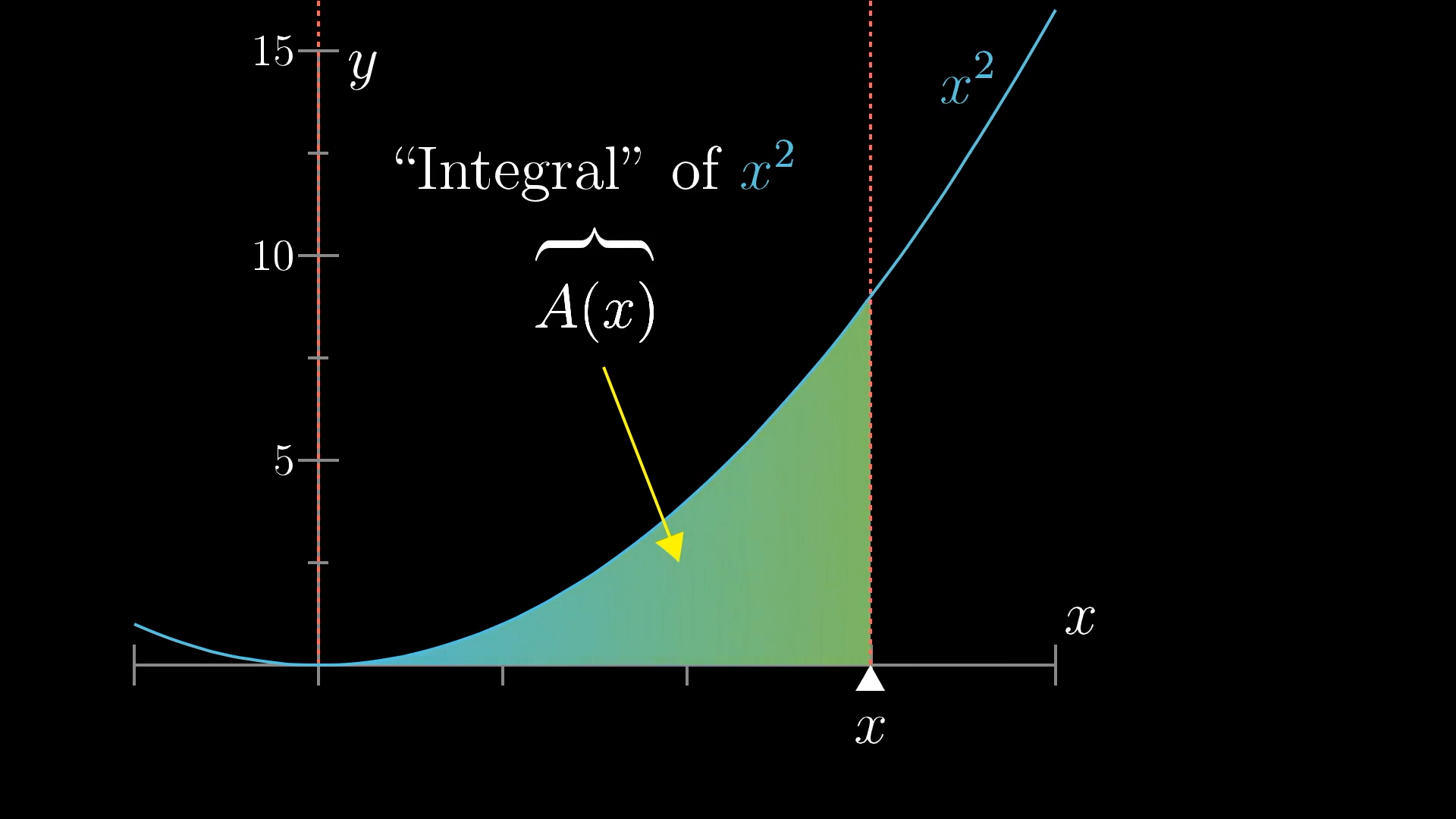
Remember that a definite integral computes the area under a curve between two points. In the image above, we’re finding the area under the curve from to .
A Trick Question
Athlete runs at 15 km/h. Athlete is 7.5 km away from finish line. Bird flies at instantaneous velocity of 30 km/h. Bird starts from athlete, flies toward finish line, and turns back toward athlete. Repeats until athlete crosses finish line.
How many km does the bird fly?
If we tried drawing kinematic graphs, it would be tricky because toward the end, the bird would be oscillating very quickly between the athlete and finish line.
Zeno’s Dichotomy paradox (sometimes mixed with the Achilles and the Tortoise paradox) says that to reach a finish line, you must first get halfway there, then half of the remaining distance, then half of that, and so on. Since there are infinitely many halfway points, Zeno argued that motion should be impossible.
Answer: 7.5 km in 15 km/h = 0.5 h. Bird flies at 30 km/h for 0.5 h = 15 km.