
Reverse Triangle Inequality
Review reciprocal and absolute-value inequalities, then prove the reverse triangle inequality for real numbers.
Inequalities
Reciprocals and Inequalities
Removing the Absolute Value
- If , then .
- If , then or .
When to flip inequality signs
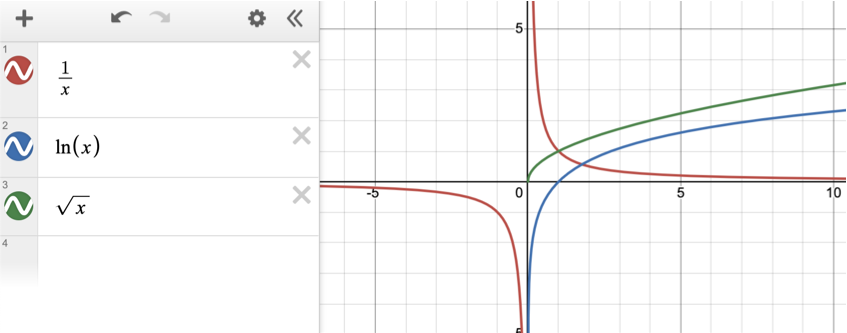
Main Rule: When taking the reciprocal of an inequality (e.g., ), you must flip the inequality sign ().
Key Condition: This rule only works if both sides have the same sign.
Examples
Both Positive:
Both Negative:
Exception
If the signs are different, the inequality sign does not flip.
- (A negative is always less than a positive).
Proof of the Reverse Triangle Inequality
The proof relies on the standard triangle inequality, which states that for any real numbers and , .
First Step
We start by writing in a convenient form: .
Now, we take the absolute value of both sides and apply the triangle inequality:
By subtracting from both sides, we get our first result:
Second Step
Similarly, we can start by writing as .
Again, we take the absolute value and apply the triangle inequality:
Subtracting from both sides gives:
Since , we can rewrite this as:
Multiplying the entire inequality by reverses the inequality sign:
Conclusion
We can now combine inequalities (1) and (2) into a single statement:
This compound inequality is the definition of the absolute value. Therefore, we can conclude:
This completes the proof. ✅